Showing posts with label Siyaah. Show all posts

Thursday, 22 August 2019

Are Pakistani Films Rising?


Are Pakistani Films Rising? Pakistan has come a long way since it has started making movies. Some movies paved way for the Cinema growth and most significant ones were Na Maloom Afrad, Jawani Phir nhi ani and Karachi Sey Lahore when people really started to believe that we should go to the cinema, now from those movies up till now we got gradual up-gradation in Frames, Cinematography, Actors get ups, and set ups but one thing is continued to be neglected is Screenplay where Bollywood once used to make trash screenplays and cringe worthy content but had changed their game of Screenplays completely, we need that excellence of our dramas scripts and excellence of Hollywood screenplays , which Bollywood strove for.

People who recently visited cinema for the latest three films said that everything was perfect, they perfectly played with colour pallets in the picture, the frames were perfect, the locations were breathtakingly beautiful and the setups were huge the get ups were stunningly beautiful but what do film makers expect from us to keep our brains at home? Some of the Cinema goers said that, you manage to produce high-quality dramas with strong content but you cannot simply produce one good movie a year in terms of content.

They say if we can make good dramas, good films may also be produced, dont make films in hassle make them with brain. Paray Hut Love and Superstar were perfect minus the screen play says public but why did they gross well people want to see cinema and if our producers are of the view that bollywood movies should remain banned forever they must try to make good films, this year viewers missed both Humayun Saeed and Nabeel Qureshi's films, they come up with all the essentials or if they dont have that, they don't even come.

They should take a bow at least they don't fool public, so far it happened. To criticize constructively doesn't mean we are haters, or blogging is just done out of hate, No it is not like that criticism means to tell them to fix the problems to grow well as Hareem did it after parchi which was a disaster, she came up with Heer Maan Ja, which is for sure way better than previous one.

Well Khalil ul Rehman Qamar's movie Kaaf kangna is releasing in October, the cast includes Sami Khan, Ishal and Neelum Munir and we have high expectations in terms of Screenplay. Humayun Saeed has also hired Khalil ul Rehman and Vasay Chauhdary for his upcoming film. Nabeel Qureshi also tweeted to fans that soon our new project will be revealed.

The Audiences crave for the good script even if the production is low at quality, great examples are Siyaah, Shah, Motorcycle Girl, Laal Kabootar. Na Maloom Afraad and Karachi Sey Lahore they were not extravagant with budget. We urge producers to please hire professional writers for films not just some new people who experiment with them at least hire the drama writers.

We really want to see cinema growing but with grace we don't want it to be taken over by foolish minds as once it was taken over by gandaasa culture.

Article Author: Sidra Ijaz 

Have something to add to the story? Share it in the comments below.

Wednesday, 19 June 2013

Siyaah has inspired film-makers, says Osman Khalid Butt

LAHORE: 
Osman Khalid Butt represents the new age of Pakistani cinema. The young actor-director seems to be aiming for an all-rounder plaque; he’s written screenplays and has acted in several projects. He has plans to sit in the director’s chair as well.
Butt penned down the screenplay for the film Siyaah — the dream of young aspiring film-makers which turned into a prominent release this year. Despite receiving mixed reviews, he feels Siyaah has opened several doors of opportunities.
“It has given a lot of people inspiration — people who thought making a film wasn’t possible but always had it at the back of their minds, now know that it’s possible,” explains Butt.
After years of desolation, these are interesting times for the film industry as a new breed of film-makers from diverse backgrounds are trying their luck at the art of film-making. Butt started his career in theatre under director Shah Sharabeel in 2005 and left his imprints in the industry. He then continued to pursue the love of this craft and got involved in parody and creative writing and this is how Siyaah was added to his resume.
Butt was approached by producer Imran Kazmi, who was struggling to bring the pieces together. Siyaah is a horror film which focuses on a couple who adopts a girl after losing their only child. Butt had played a supporting role in a horror film before, Omar Ali Khan’sZibakhana, but had little experience writing a screenplay in Urdu.
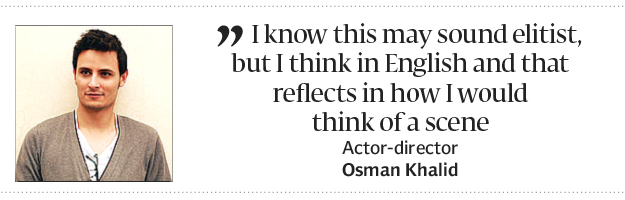
“The thing is, I know this may sound elitist, but I think in English — and that reflects in how I would think of a scene [in my mind],” he admits. “Having said that, it was pretty easy to translate at times though.”
Gliding through the challenges, Butt says that he learnt a lot from this experience as he had written the script two-and-a-half years ago. His love for the medium triggered the process and he aimed to create characters that would have lasting impressions on the audience. “We would debate if the horror genre was too niche for Pakistan. But we realised that we could think outside the box and move beyond the gandasa,” he continues.
Butt reveals that he has received several offers from both television and cinema to further showcase his acting talent. His ultimate desire, however, remains to be directing a film — something he is working on currently. He keeps himself busy compiling ideas for short stories which he hopes to start shooting soon. “I’ve always loved acting on stage but I have always imagined myself directing a larger than life or a very masala Bollywood film, due to my upbringing and the type of influences I had growing up,” he says.
Summing up the glory of Siyaah and the prospects of Pakistani cinema, Butt is quick to admit there has been a radical shift from the traditional norms of Lollywood. “If I were to condense it [the situation] in two words, then I would say it’s been quite a revolution,” he says, adding that although there has been talk that the audience has lost interest, one thing is for certain and that is that this industry is all about entertainment. “There is a genuine determination and for the first time [in history], people are looking at this [field] where a possible career can be made.”
“Although people are not expressing it openly, there is genuine excitement [in the air], and within the next three or four years, this could be the beginning of something great for Pakistani cinema,” he adds enthusiastically.
Butt is set to feature in a play called Om Zara and a Ramazan special which will be aired on television. He currently isn’t planning on writing any screenplays but admits it could definitely be a possibility in the future.

Thursday, 21 March 2013

The horror film Siyaah is old wine in a new bottle, but its worth a watch


Pakistani cinema has been lying dormant for the most part ever since the release of Shoaib Mansoor’s Bol, followed by the done-to-death phrase ‘revival of Pakistanicinema’ which surfaced yet again. Pakistani cinema though never picked up as was expected. The number of releases post Shoaib Mansoor’s magnum opus could at best be described as paltry, generally consisting of commercial pot-boilers with gun-wielding thugs being seduced by stout, gaudily clad women gyrating to screechy music.  
However the entertainment industry of late has been abuzz with talks of a number of promising films which are purportedly in the pipeline. Making a film in this part of the world, it goes without saying, is no easy feat. A lack of adequate infrastructure, financial constraints and an absence of a professional industry bereft of any government support impede the process of producing and releasing a film. The high budget multi-starrer Waar still has not seen the light of day, while a film like Lamha – Seedlings, which garnered much international acclaim, is yet to be released nationally.
In light of the non-conducive environment for filmmakers in Pakistan, it comes as a symbolic achievement when an independent, low-budget film such as Siyaah made by a group of youngsters is released commercially. The film has been produced by Imran Kazmi, directed by Azfar Jaffri and written amongst others by Osman Khalid Butt.
The promotions of the film started on social media, with short teaser trailers generating numerous hits. This modest promotion soon gave way to its trailer being played on major television networks, a first for a small-scale venture of this kind.
The title Siyaah aptly embodies the cryptic content of this hair-raising horror flick. The story revolves around a married couple, Bilal (Jabbar Naeem) and Zara (Hareem Farooq) who move into a new house on the outskirts of Islamabad following a personal tragedy. They decide to adopt a child to mitigate their woes and the plot thickens. Little Natasha (Mahnoor Usman), is no regular child and entangles the lives of her foster parents in a web of ominous experiences.
The concept may be old wine in a new bottle, but its screenplay and treatment make it somewhat of a nail-biting rollercoaster ride that keeps you glued to the edge of your seat until the end credits roll.
One would expect film novices namely with a theatre background to be incapable of pulling off an evocative film convincingly, but the team of Siyaah have without a doubt risen to the occasion. They have handled the concept maturely and whipped up moments that leave a lasting impact. The makers have cleverly worked around the handicap of budget constraints and refrained from adding overambitious special effects which could potentially seem substandard. They have instead focused on eerie background music (by Ahmed Ali), long pauses and a tight screenplay which prove highly effective in exacting horror.
Some clever editing with rapid montage sequences make for powerful viewing and leave the viewer shaken up. The director employs unconventional techniques like the use of black frames when the drama is at its pinnacle. With only sound taking the narrative forward for those few seconds, one is left to imagine the unfolding horror. This evokes fear and perplexity in an overpowering manner. While staring at the black screen one is left feeling desolate in the eerie world of Siyaah to experience the trauma the characters are undergoing.
Osman Khalid Butt’s writing is to be lauded for its incredible ability in generating moments of horror, which often jolt you. He constructs the scenes in an unpredictablefashion which leave you twiddling your thumbs in nervous anticipation, eventually leading to a climax that has you stupefied. The writing thankfully steers clear of clichés and employs creativity in fleshing out intimate interactions between the protagonists in unnerving situations which really resonate with the viewer.
Mahnoor Usman stands out as an actor for she is the centerpiece of the atmosphere of horror and lives up to her role. She has an incredible command over her expressions for a girl her age and captures the coy and venomous subtext of her character quite remarkably.
Hareem Farooq, who has many noted theatre projects including Pawnay 14 August to her credit, makes her film debut in Siyaah and has a challenging role at hand as her character finds herself in a predicament. She stars as the harried woman who has the unenviable responsibility of being a mother to a girl who exhibits supernatural tendencies. Hareem in particular is strong at delivering emotional scenes and portrays the peculiar dilemma her character has to face with great honesty. Nonetheless, some of the scenes where she has to express anger or incredulity leave you craving for more.
Bilal is a young and cocky construction worker and a loving husband who provides solace to his anguished wife. His character has some of the meatier sequences in the film which he enacts with the potency that is required from him. One of his scenes to look out for, is the mirror sequence that is gritty and jarring and one of the high points of the film. That said, Jabbar Naeem in some scenes appears to hold back his expression which makes his rendition appear a bit linear.
Ahmed Ali who plays a journalist interviewing Zara, exudes a certain charm on screen and delivers a nuanced performance. He is compelling in his portrayal of a clinical and calculating man and keeps a restraint about himself.
The film’s grotesqueness is nicely balanced with some light moments and witty pop culture references. These seemed to go down well with the cinema audience who for instance were giggling away to an allusion made to pea soup while mocking Hollywood exorcism flicks.
The audience was quite responsive and gasped and screamed at the scary moments and lamented at the sad ones, discussing the film’s developments in whispers. For the duration of the film they were completely engrossed in the world of Zara, Bilal and Natasha.
Though the story of Siyaah is based in an upper-middle class, urban setting, the content of the film is such that it would have a wide outreach since the rousing situations explore universal fears, making you tread those dark corners of your imagination that send a chill down your spine.
It must be underscored that though the film is the work of newcomers who lacked access to state-of-the-art facilities, due attention needs to be paid to technical aspects of film production. Many of the scenes in the first half of the film appear fuzzy, with some falling victim to improper focusing which gives some frames an amateurish look. Moreover some of the shots aren’t composed with a cinematic sensibility and lack the presentation that one would expect from a feature film. There were even some minor inconsistencies on the dubbing front in the initial reels of the film. But even with all its shortcomings Siyaah is far superior to many of the outlandish Bollywood films belonging to the horror genre.
Lollywood has always been under the shadow of Bollywood for all these years as the predominant format of the two industries is similar but India is miles ahead in terms of their films’ production values. The Indian movie industry thus has come to represent South Asian cinema internationally. The only way forward for Pakistani filmmakers to cultivate a distinct identity for Pakistani cinema is by producing independent films which are innovative in terms of script and film technique and carry a unique style that sets then apart. Iranian cinema is perhaps one to look up to as it is known for its hard-hitting storylines and robust production. As far as independent cinema in Pakistan goes, Siyaah will go down in Pakistan’s film history as a triumph for independent filmmakers since it has managed to find distribution nationwide which many other films failed in achieving and thus stands shoulder to shoulder with the Hollywood and Bollywood biggies competing for the same screening slots.

Thursday, 14 March 2013

Did you know? Horror flick Siyaah hits theaters March 15

Pakistani horror flick Siyaah will be screened at select cinemas in Karachi, Lahore and Islamabad on March 15.
 Siyaah, which revolves around the use of black magic, has been directed by Asfar Jafri and written by Islamabad’s local celebrity, comedian Osman Khalid Butt. Producer Imran Raza Kazmi said, “Our entire team is extremely passionate about Siyaah and we have put our 110%into it. We believe that its success will push Pakistani cinema in a new direction and support the efforts of new local film-makers like us who put everything they have into their projects.”
Kazmi hopes that Siyaah will revive our film industry and we will see many new movies in cinemas in the future.
The Islamabad-based cast consists of Hareem Farooq, Qazi Jabbar, Mahnoor Usman, Ahmed Ali Akbar, Aslam Rana, Sofia Wanchoo Mir, Rizwana, Sarwar Salimi, and Amy Saleh — aspiring young actors that are aiming to make a mark with the release of this film.
The movie ticket is priced between Rs350 to Rs400, while the film is expected to run for two weeks. A red carpet event, featuring the cast and crew, will be held in Karachi on March 16. Go buy your tickets to support Pakistani cinema!

Wednesday, 6 March 2013

Siyaah - A project backed by theatre artists

Siyaah will be the actors’ first feature film.
LAHORE: 
Theatre actors stick to theatre and movie stars tend to stick to movies but such isn’t the case with small-budget horror flick Siyaah, which has witnessed the journey of local theatre actors shifting to the sets of a feature film. Set to release nationwide on March 15, Siyaah revolves around the existence of exorcism, black magic and superstitious minds in our society.
Produced by Imran Raza Kazmi, the film includes actors from the local circuit in Islamabad such as Hareem Farooq, Qazi Jabbar and Ahmed Ali Akbar amongst several others. The screenplay has been written by Osman Khalid Butt, owner of Living Picture Productions.
Siyaah will be the actors’ first feature film.
In the actors’ shoes
“I have predominantly done comedy roles and for me, it’s always been more natural,” says Hareem Farooq, who is playing a serious role for the first time — a wife who cannot bear a child. “When I met Imran, I was sure that this film would be worthwhile — it’s because he had a plan, which is very important.” Farooq is a known name in theatre and has been acting for nearly five years. Her recent plays include Act 144 and Aangan Terrha.
Farooq admits the popularity she gained through her work in theatre and Siyaah have opened more doors for her, as well as for her co-stars. “Being an actor, it’s important for me to do character roles. It gives me space to play with and this has been the case in theatre as well,” she says. She has received TV show offers but will only jump into that stream of entertainment if the production quality is good.
When comparing theatre with cinema, Farooq feels that stage performances are much more exaggerated than those in films — acting in a film was more natural for her as it didn’t focus too much on body movements.
Another actor starring in the film is Qazi Jabbar whose first major play was in 2009; he has been involved in theatre since he was in school and reveals he featured in a couple of music videos as well.
“Everyone in this project is a newcomer but I know that each person has put in a lot of hard work,” says Jabbar, who plays the role of Farooq’s loving husband who is an architect by profession. “It was a collaborative effort — we all had to contribute whatever acting experience we had to ensure that the characters came out right.”
Jabbar explains the film plays on emotions; it shows a struggling couple who adopt a child and then eerie things begin to happen. “The Pakistani public is very emotional — the movie shows how relationships get strained by black magic and possessions by spirits,” he continues. “So there are different elements in the film.”
Ahmed Ali Akbar, who has worked closely with the play’s screenwriter Butt on a number on instances, has been doing theatre for some time now; he also appeared in the Urdu adaptation of Taming of the Shrew.
“If you look historically, a thriller has the longest shelf life when it comes to films,” says Akbar, adding that people normally pick up horror flicks at DVD stores. He plays the role of a young journalist who goes on X-Files like investigations and interviews Farooq, who has adopted a young girl.
“For a theatre actor, it’s always a little difficult to do films because you go in and out of characters so fast,” he adds.
Akbar feels the film’s biggest achievement is that it is releasing nationwide. “The problem is that we don’t have producers — people who can take films to the cinema,” he admits, adding that at least 15 to 20 films are currently under production in the country which shows that there isn’t a shortage of actors. “We are just short on producers.”

Tuesday, 29 January 2013

Siyaah may pave way for indie film-makers

LAHORE: 
Independent horror thriller Siyaah, which is scheduled for a nationwide release on March 15, deals with the themes of black magic and exorcism.
The film’s director Azfar Jafri, a self-taught film-maker based in Islamabad, joined the project after producer Imran Raza Kazmi tried out several screenwriters and directors.
“I am not a horror film director or anything,” says Jafri. “We don’t how the critics or masses will take the film, but the way we have treated the film should make it as different as possible.”
Producer Kazmi, who has limited experience with film, also seems unperturbed by the odds of making a horror film for a Pakistani audience. “After I saw Omar Khan’s Zibahkhana, it really got me thinking; if one person can make a good quality film, then we can too,” says Kazmi. The process hasn’t been easy, since he has changed three screen writers and put in several months of research regarding the film’s themes. “My goal was to create something different to show another side to Pakistani film-making,” Kazmi adds. “It is different fromZibahkhana and horror films from the ‘60s and ‘70s. It has suspense and drama — we have tried to create a balance of all the perfect ingredients.”
The film includes several actors from the local circuit in Islamabad, such as Hareem Farooq, Qazi Jabbar, Mahnoor Usman, Ahmed Ali Akbar, Aslam Rana, Sofia Wanchoo Mir, Rizwana, Sarwar Salimi and Amy Saleh. Owner of Living Picture Productions Osman Khalid Butt has written the screenplay.
“The people we have chosen were already in the theatrical scene; they knew that Kazmi could pull it off and we could produce something really good,” says Jafri. Speaking about the low profile and publicity the film has maintained, Jafri explains that the team has been focusing on ensuring that the film is completed before speaking to the media. “It is a negative reflection on your credibility when you start talking about a film and it turns out to be different.”
On the bright side
While audiences should hold their breath for what the film-makers promise will be a different experience, Siyaah could also be a breakthrough Pakistan’s film industry.
Films with smaller budgets usually find it difficult to reach cinemas because of distribution problems, but Siyaah seems to have been lucky. “I know of several films that are ready in Pakistan but don’t find distribution,” says Kazmi. Fortunately, the horror flick has secured major distribution thanks to Cinepax Cinema, whose parent company is Footprint Entertainment. “This was the best way to get our film to theatres,” explains Kazmi.
Marketing manager of Cinepax Limited Mohsin Yaseen explains that while Footprint Entertainment has been involved in the distribution of films from major companies such as Universal Studios, Paramount Pictures and DreamWorks, over the last few years the company has spearheaded the resurgence of local cinema in Pakistan by making it a priority to support local films.
Yaseen explains that even after securing distribution, future of local films depends on the content. Film-makers will have to be creative and get away from old and worn-out themes which intelligent and aware audiences do not appreciate.
“People don’t want to see dancing in the fields or things of that nature,” says Yaseen. “The audience is much more sophisticated and comes prepared to watch a film after looking at trailers and reading reviews. We think that Siyaah provides that content.”